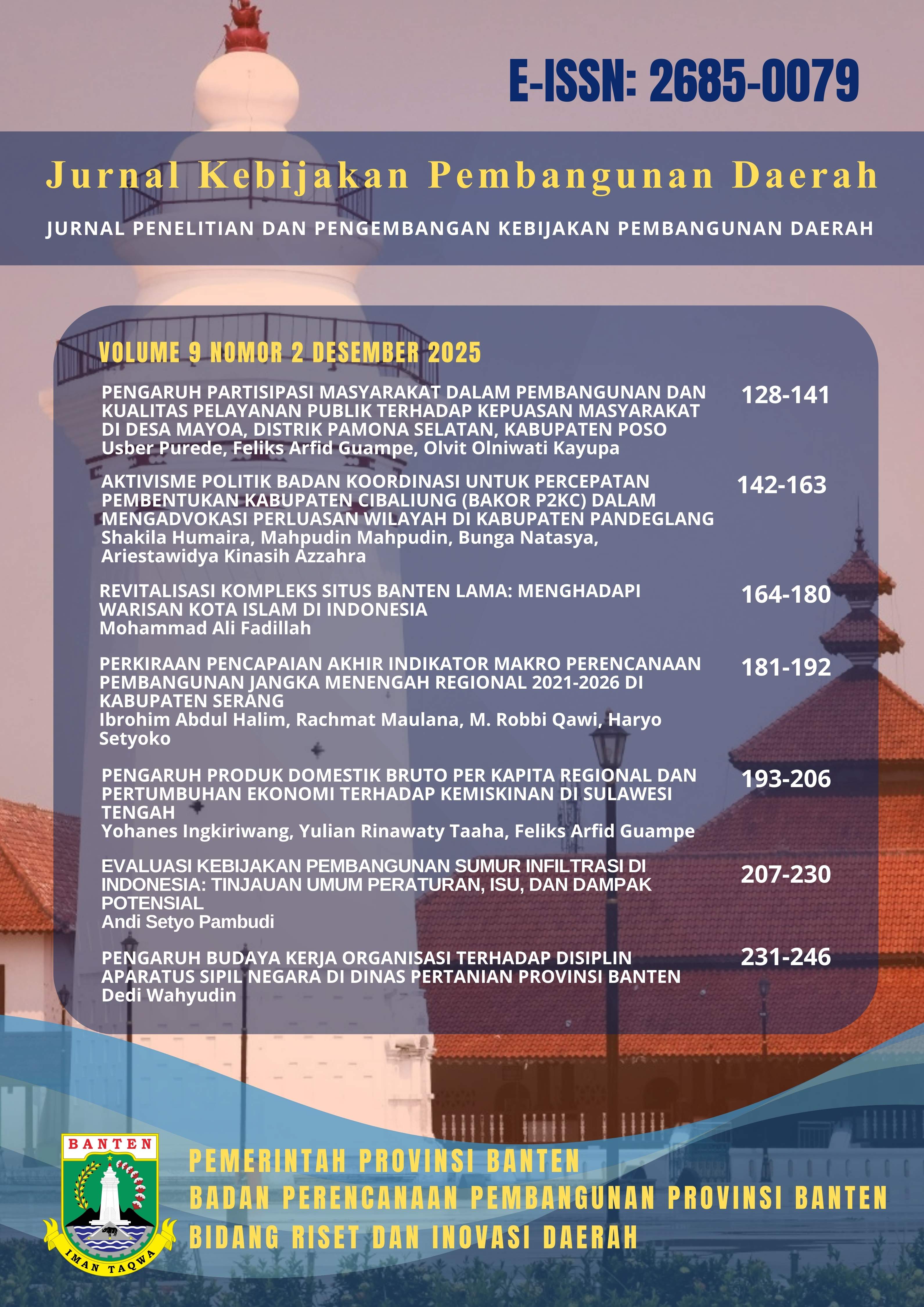
POLITICAL ACTIVISM OF THE COORDINATION BODY FOR THE ACCELERATION OF THE FORMATION OF CIBALIUNG REGENCY (BAKOR P2KC) IN ADVOCATING FOR REGIONAL EXPANSION IN PANDEGLANG REGENCY
DOI:
https://doi.org/10.56945/jkpd.v9i2.363Keywords:
Regional Expansion, Local Autonomy, Territorial Coalition, Political DynamicsAbstract
Territorial expansion is a significant phenomenon in Indonesia's administrative and political context, often emerging as a response to the public's need for better public services and more efficient resource management. This study describes the processes and challenges in the effort to establish Cibaliung Regency as a concrete example of local autonomy aspirations. Through an analysis of territorial coalitions and political dynamics, this research highlights the role of political actors, such as local community organizations and regional governments, in forming alliances to achieve territorial expansion goals. The desire of the Cibaliung community to become an autonomous region is driven by several factors, including challenges in accessing public services and perceptions of unequal development. The region's significant economic and tourism potential also serves as a major incentive for territorial expansion. However, the expansion process faces significant obstacles, including the national moratorium that has halted most expansion proposals in Indonesia, as well as bureaucratic challenges and complex political competition. This study identifies that while territorial expansion promises substantial benefits for more effective local governance, this approach also poses risks to the economic stability of the parent region and social integration in the newly formed area. The social, economic, and legal implications of territorial expansion must be carefully managed to minimize negative impacts and maximize positive benefits for all stakeholders involved.
References
Adyawarman. (2021). The Challenges of Public Innovation : Insights From Risk Governance in Batang Regency. Jurnal Kebijakan Dan Administrasi Publik, 25(1), 1–24. https://jurnal.ugm.ac.id/jkap/article/view/62314/31602
Agustino, L. (2010). Dinasti Politik Pasca-Otonomi Orde Baru: Pengalaman Banten. Prisma, 29, 102–116.
Agustino, L., & Yusoff, M. A. (2008). Proliferasi dan etno-nasionalisme daripada pemberdayaan dalam pemekaran daerah di Indonesia. Bisnis & Briokrasi, 15(3), 196–201.
Antlöv, H., & Wetterberg, A. (2014). Village Governance , Community Life , and the 2014 Village Law in Indonesia. 1–40.
Cheema, G. S., & Rondinelli, A., D. (2007). Decentralizing Governance: Emerging Concepts and Practices. Brookings Institution Press, Ash Institute for Democratic Governance and Innovation. https://www.jstor.org/stable/10.7864/j.ctt1261v1
Cheema, G. S., & Rondinelli, D. A. (1983). Decentralization and development: policy implementation in developing countries. In Decentralization and development: policy implementation in developing countries. (Issue 581).
Creswell. (2014). Penelitian Kualitatif & Desain Riset (3rd ed.). Pustaka Pelajar.
Eilenberg, M. (2009). Negotiating autonomy at the margins of the state the dynamics of elite politics in the borderland of West Kalimantan, Indonesia.
South East Asia Research, 17(2), 201–227. https://doi.org/10.5367/000000009788745831
Hidayat, R. (2015). Otonomi Daerah dan Demokrasi Lokal di Indonesia. Pustaka Demokrasi.
Hidayati, F. (2017). Can decentralization affect public service delivery? A preliminary study of local government’s innovation and responsiveness in Indonesia. Firda Hidayati/ JPAS, 1(3), 80–86.
Kimura, E. (2010). Proliferating provinces: Territorial politics in post-Suharto Indonesia. South East Asia Research, 18(3), 415–449. https://doi.org/10.5367/sear.2010.0005
Kuncoro, M. (2012). Ekonomi Pembangunan: Teori dan Aplikasi. UPP STIM YKPN.
Mahpudin, M., Indriyany, I. A., & Hikmawan, M. D. (2021). Between Elites and Society: The Politics of Territorial Splits in a Decentralizing Era, Case of
Lebak District, Indonesia. Journal of Governance, 6(1). https://doi.org/10.31506/jog.v6i1.11019
Pratiwi Sofia, A., & Sutanto, H. (2023). Dampak Pemekaran Desa Pada Kehidupan Sosial Dan Ekonomi Di Desa Sama Guna, Kecamatan Tanjung. Journal of Economics and Business, 9(1), 14–22. https://doi.org/10.29303/ekonobis.v9i1.127
Ramdhani, H., Politik, D. I., Indonesia, U., Cirebon, K., Indramayu, K., Daerah, P., & Ekonomi, S. D. (n.d.). DINAMIKA ELITE POLITIK LOKAL MENGENAI ISU. 3, 182–203.
Rohmah, N. S., & Rohmah, N. S. (2018). Elit Dan Pemekaran Daerah; Konflik Antar Elit Dalam Proses Pembentukan Provinsi Banten. CosmoGov, 4(2), 173. https://doi.org/10.24198/cosmogov.v4i2.16133
Smith, B. C. (1985). Decentralization The Territorial Dimension of the State. Allen & Unwin.
Suryanto, S. (2013). Pemekaran Daerah di Indonesia. Jurnal Desentralisasi, 11(1), 359–370. https://doi.org /10.37378/jd.2013.1.359-370
Downloads
Published
Issue
Section
License
Copyright (c) 2025 Jurnal Kebijakan Pembangunan Daerah

This work is licensed under a Creative Commons Attribution-NonCommercial-ShareAlike 4.0 International License.

Jurnal Kebijakan Pembangunan Daerah is licensed under a Creative Commons Attribution-NonCommercial-Sharealike 4.0 International License.



.png)