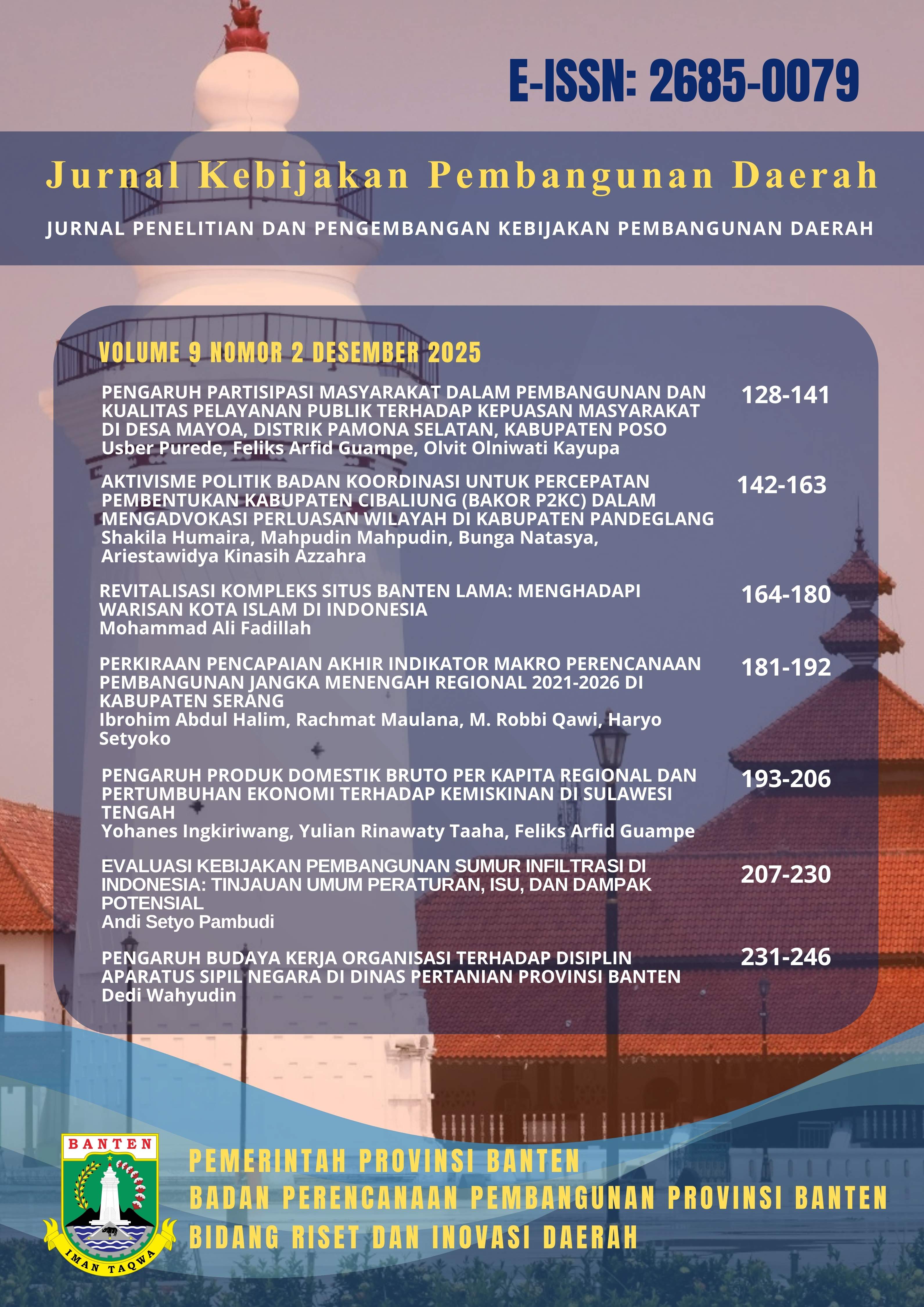
DEVELOPMENT POLICIES EVALUATION OF INFILTRATION WELLS IN INDONESIA: OVERVIEW OF REGULATIONS, ISSUES AND POTENTIAL IMPACTS
DOI:
https://doi.org/10.56945/jkpd.v9i2.353Keywords:
Infiltration Wells, Policy, Water Resources, RegulationAbstract
Climate change, rapid urbanization, and land-use conversion have disrupted Indonesia’s hydrological balance, leading to frequent floods during the rainy season and water scarcity during dry periods. Infiltration wells have emerged as a technical solution for water conservation, yet their implementation remains suboptimal. Previous studies have primarily focused on technical aspects, while integrated evaluations covering regulatory, institutional, and socio-economic dimensions are still lacking. This research addresses that gap by comprehensively evaluating infiltration well policies to support national water resilience targets. The study aims to analyze regulatory frameworks, identify technical and institutional challenges, and formulate sustainable development strategies. Using a qualitative approach, the research combines literature review of laws, standards, and academic journals with a Focus Group Discussion (FGD) involving 15 participants from water agencies in five provinces. Three key findings emerged: (1) infiltration wells are not yet integrated into regional planning documents such as RPJMD and spatial plans; (2) technical quality and maintenance systems are weak and inconsistent; and (3) cross-sectoral coordination and community involvement are minimal. Policy recommendations include harmonizing national-local regulations, mandating basic hydrogeological assessments, establishing inter-agency task forces, and offering incentives for developers and communities. The study highlights the urgency of collaborative, region-specific approaches to scale up infiltration well development in Indonesia.
References
Angguniko, B. Y. (2010). Persepsi Masyarakat Terhadap Teknologi Sumur Resapan Air Hujan Dan Lubang Resapan Biopori (Studi Kasus: Kabupaten Tangerang Selatan). Jurnal Sosial Ekonomi Pekerjaan Umum, 2(1), 9–19. bit.ly/3WMSWJc
Azwarman, A. (2017). Kajian Sumur Resapan Antisipasi Genangan Air pada Perumahan Permata Kenali untuk Pencegahan Banjir. Jurnal Ilmiah Universitas Batanghari Jambi, 15(2), 1–5. https://doi.org/http://dx.doi.org/10.33087/jiubj.v15i2.173
Bahunta, L., & Waspodo, R. S. B. (2019). Rancangan Sumur Resapan Air Hujan sebagai Upaya Pengurangan Limpasan di Kampung Babakan, Cibinong, Kabupaten Bogor. Jurnal Teknik Sipil Dan Lingkungan, 4(1), 37–48. https://doi.org/https://doi.org/10.29244/jsil.4.1.37-48
Bunganaen, W., Sir, T. M. W., & Penna, C. (2016). Pemanfaatan sumur resapan untuk meminimalisir genangan di sekitar jalan cak doko. Jurnal Teknik Sipil, 5(1), 67–78. https://jurnalindustri.petra.ac.id/index.php/jurnal-teknik-sipil/article/view/19817
Daniel, J., Neolaka, A., & Nasution, N. (2012). Kesadaran Masyarakat dalam Pembuatan Sumur Resapan Air Hujan (Studi pada RW. 02 Kelurahan Kebon Jeruk, Jakarta Barat). Menara: Jurnal Teknik Sipil, 7(1), 1–14. bit.ly/3C95dhF
Diandra, N., Afla, M. N., & Saputra, M. O. (2020). Tinjauan Rumah Tinggal Berdasarkan Konsep Rumah Sehat Menurut Regulasi Pemerintah. Jurnal Teknologi Dan Desain, 1(2), 45–54. https://doi.org/https://doi.org/10.51170/jtd.v1i2.20
Fransiska, A. (2022). Right to health on access to clean water in Indonesia. International Journal of Research in Business & Social Science, 11(6). https://doi.org/10.20525/ijrbs.v11i6.1973
Gunawan, T. A., Sarino, S., Juliana, I. C., Iryani, S. Y., & Rachmadi, A. (2021). Rancang Bangun Sumur Resapan Air Hujan Pada Lingkungan Perumahan Dalam Upaya Pengurangan Volume Limpasan. Jurnal Pengabdian Community, 3(2), 54–59. http://ejournal.ft.unsri.ac.id/index.php/community/article/view/1034
Hatmoko, J. U. D., Wibowo, M. A., Hidayat, A., Khasani, R. R., Hermawan, F., Herdiva, U. K., & Cahyani, A. D. (2021). Pembuatan Sumur Resapan Sebagai Upaya Peningkatan Cadangan Air Tanah dan Pengendalian Banjir di Kecamatan Tembalang. Jurnal Pasopati: Pengabdian Masyarakat Dan Inovasi Pengembangan Teknologi, 3(1). https://doi.org/https://doi.org/10.14710/pasopati.2021.9694
Iriani, K., Gunawan, A., & Besperi, B. (2013). Perencanaan sumur resapan air hujan untuk konservasi air tanah di daerah permukiman (studi kasus di Perumahan RT. II, III, dan IV Perumnas Lingkar Timur Bengkulu). Inersia: Jurnal Teknik Sipil, 5(1), 9–22. https://doi.org/https://doi.org/10.33369/ijts.5.1.9-22
Jamil, M. H., Salam, M., Tenriawaru, A. N., Hardiyanti, Siti, Ramadhani, Anggun, & Bidangan, A. M. (2023). The effectiveness of agricultural extension in rice farming : Employing structural equation modeling in search for the effective ways in educating farmers. Journal of Agriculture and Food Research, 18(October), 1–17. https://doi.org/10.1016/j.jafr.2024.101487
Kalwa, F., Binder, M., Händel, F., Grüneberg, L., & Liedl, R. (2021). Biological and physical clogging in infiltration wells: effects of well diameter and gravel pack. Groundwater, 59(6), 819–828. https://doi.org/https://doi.org/10.1111/gwat.13104
KLHK. (2022). Surat Keputusan Direktur Jenderal Pengendalian Daerah Aliran Sungai dan Hutan Lindung Nomor: : SK.12/PDASRH/SET/REN.0/3/2022 tentang Rencana Strategis Direktorat Jenderal Pengendalian Daerah Aliran Sungai dan Hutan Lindung Tahun 2020 -2024. https://pdasrh.menlhk.go.id/userfiles/~masagus/files/Revisi Renstra Ditjen PDASRH 2020-2024.pdf
Krueger, R. A., & Casey, M. A. (2015). Focus Groups: A Practical Guide for Applied Research (5th ed.). SAGE Publications.
Kusuma, A. C., Pratiwi, N. W. W., Humairah, N. A., & Yulistio, M. R. (2022). Analisis Dampak Kebijakan Populis Terhadap Keputusan Gubernur DKI Jakarta. Jurnal Analisis Hukum, 5(1), 90–105. https://doi.org/https://doi.org/10.38043/jah.v5i1.3491
Lubis, H., Siregar, I., Sarman, E., & Sofie, T. M. (2023). Penyuluhan Sistem Drainase dan Sumur Resapan di Desa Pulau Sejuk Kecamatan Datuk Lima Puluh Batu Bara. Jurnal Pengabdian Kontribusi Unhamzah, 2(2), 42–48. http://jurnal.unhamzah.ac.id/index.php/japsi/article/view/66
Machi, L. A., & McEvoy, B. T. (2022). The Literature Review: Six Steps to Success (4th ed.). SAGE Publications.
Mardiah, A. M., Ainy, C. N., Bagus, M., & Harlan, D. (2018). Study on the Effectiveness of Infiltration Wells to Reduce Excess Surface Run Off In ITB. MATEC Web of Conferences, 147, 3008. https://doi.org/https://doi.org/10.1051/matecconf/201814703008
Maryono, A., Nuranto, S., Sembada, P. T. S., & Petrus, H. T. B. M. (2022). GAMA-RainFilter: a modified rainwater harvesting technique to meet the demand of clean water in Indonesia. International Journal of Hydrology Science and Technology, 13(1), 1–22. https://doi.org/https://doi.org/10.1504/IJHST.2022.119272
Masthura, L., Wignyosukarto, B. S., Fahriana, N., & Ardhyan, M. Z. (2023). Keterpaduan Lintas Sektoral Dalam Pengembangan Kebijakan Integrated Water Resources Management (IWRM) pada Wilayah Sungai Aceh Meureudu Provinsi Aceh. Jurnal Daur Lingkungan, 6(1), 40–47. https://doi.org/http://dx.doi.org/10.33087/daurling.v6i1.199
Molya, R., Rintis Hadiani, R. R., & Muttaqien, A. Y. (2021). Infiltration Wells as an Alternative Eco Drainage System a Case Study in Mangkubumen Surakarta. International Conference on Rehabilitation and Maintenance in Civil Engineering, 953–964. https://doi.org/https://doi.org/10.1007/978-981-16-9348-9_84
Mukaromah, H. (2020). Rainwater harvesting as an alternative water source in Semarang, Indonesia: the problems and benefits. IOP Conference Series: Earth and Environmental Science, 447(1), 12059. https://doi.org/https://doi.org/10.1088/1755-1315/447/1/012059
Muntaha, Y., Prayogo, T. B., & Yuliani, E. (2022). Permodelan Sumur Resapan Inovatif untuk Konservasi Air Tanah Permeabilitas Rendah Daerah Kota Malang. Jurnal Teknik Pengairan, 13(1), 36–47. https://doi.org/https://doi.org/10.21776/ub.pengairan.2022.013.01.04
Nurkhotiah, S., Kamari, K., Furqorina, R., & Firdaus, M. I. (2023). Pelestarian Sumber Daya Air Tanah Dengan Sumur Resapan Di Kampung Kost Gendingan, Jebres, Surakarta. Jurnal Pendidikan Dan Konseling (JPDK), 5(1), 1238–1243. https://doi.org/https://doi.org/10.31004/jpdk.v5i1.11144
Nurwidyaningrum, D., Sari, T. W., Wulandari, L. S., Wajih, A., & Damianto, B. (2023). Penerapan Rain Water Harvesting pada Sumur Resapan untuk Kawasan Rawan Banjir. Wikrama Parahita: Jurnal Pengabdian Masyarakat, 7(1), 123–127. https://doi.org/https://doi.org/10.30656/jpmwp.v7i1.5411
Nyoto, R. L. V., & Ruldeviyani, Y. (2022). Infiltration Wells Program in Jakarta: Twitter Sentiment Analysis. 2022 1st International Conference on Information System & Information Technology (ICISIT), 352–357. https://doi.org/https://doi.org/10.1109/ICISIT54091.2022.9872911
Pambudi, A. S. (2022a). Balancing infrastructure, ecosystem conservation, and community approaches on integrated development planning of Citarum Watershed. Indonesian Journal of Applied Environmental Studies (InJAST), 3(1), 34–41. https://doi.org/10.33751/injast.v3vi1i.4209
Pambudi, A. S. (2022b). Sinkronisasi Perencanaan Pembangunan Top-Down Dan Bottom-Up Tentang Pembangunan Air Minum: Studi Kasus Di Provinsi Jawa Tengah. Jurnal Ilmiah Wahana Bhakti Praja, 12(1), 23–43. https://doi.org/https://10.33701/jiwbp.v12i1.2335
Pambudi, A. S. (2024). Drinking Water Development Plan Evaluation Through Transfer to Regions Fund. Jurnal Perencanaan Pembangunan: The Indonesian Journal of Development Planning, 8(3), 410–434. https://doi.org/10.36574/jpp.v8i3.484
Pambudi, A. S., & Kusumanto, T. (2023). Water Resources Governance in Indonesia Towards Environmental Sustainability Along with Social and Economic Development. In Environmental Governance in Indonesia (Vol. 61, pp. 289–311). Springer, Cham. https://doi.org/10.1007/978-3-031-15904-6_16
Prayitno, G., Bisri, M., Juwono, P. T., Anwar, M. R., Harimurti, H., Sari, N., Dinanti, D., & Wigayatri, M. (2021). Planning and Assistance the Making of Infiltration Wells. JCES (Journal of Character Education Society), 4(1), 212–220. https://doi.org/https://doi.org/10.31764/jces.v4i1.3564
Pribadi, K. S., Abduh, M., Wirahadikusumah, R. D., Hanifa, N. R., Irsyam, M., Kusumaningrum, P., & Puri, E. (2021). Learning from past earthquake disasters: The need for knowledge management system to enhance infrastructure resilience in Indonesia. International Journal of Disaster Risk Reduction, 64, 102424. https://doi.org/https://doi.org/10.1016/j.ijdrr.2021.102424
Rafsanjani, T. M., Rahmayani, R., Bahri, S., Rosita, S., & Nuzula, A. (2020). Persepsi Masyarakat Dalam Penerapan Sumur Resapan Di Desa Blang Tambeu Kecamatan Simpang Mamplan Kabupaten Bireuen. Jurnal Serambi Akademica, 8(3), 518–524. https://doi.org/https://doi.org/10.32672/jsa.v8i3.2231
Sajar, S. (2021). Penguatan Kapasitas Para Pihak Tentang Konservasi Sumber Daya Air Melalui Pembuatan Sumur Resapan di Nagori Rukun Mulyo Kecamatan Panombean Pane Kabupaten Simalungun. Ihsan Jurnal Pengabdian Masyarakat, 1(1), 133–143. https://doi.org/https://doi.org/10.30596/ihsan.v3i2.8051
Satriawansyah, T., Haryanto, I., Israjunna, I., Najimuddin, D., & Badaruddin, B. (2020). Eksistensi Pembangunan Sumur Resapan Di Kabupaten Sumbawa: Sebagai Kajian Akademik Dalam Penyusunan Rancangan PERDA. PROSIDING SEMINAR NASIONAL IPPeMas, 1(1), 632–638.
Setiabudi, B. (2009). Pencegahan Banjir, dan Penurunan Muka Air Tanah dengan Sumur Resapan. METANA, 6(01), 9–15. https://doi.org/https://doi.org/10.14710/metana.v6i01.1796
Strauss, A., & Corbin, J. (1998). Basics of Qualitative Research: Techniques and Procedures for Developing Grounded Theory. SAGE Publications.
Sulistyaningsih, T., Nurmandi, A., Salahudin, S., Roziqin, A., Kamil, M., Sihidi, I. T., Romadhan, A. A., & Loilatu, M. J. (2021). Public Policy Analysis on Watershed Governance in Indonesia. Sustainability, 13(12), 6615. https://doi.org/10.3390/su13126615
Suprayogi, S., & Malawani, M. N. (2019). Urban sediment in infiltration wells: A lesson from the northern area of greater Yogyakarta city. Indonesian Journal of Geography, 51(3), 295–303. https://doi.org/https://doi.org/10.22146/ijg.33721
Wigati, R., & Ichwan, R. (2017). Teknologi Sumur Resapan dalam Kajian Pemaparan Hidrograf Banjir Sub Das Ciujung. Fondasi: Jurnal Teknik Sipil, 3(1), 12–24. https://doi.org/http://dx.doi.org/10.36055/jft.v3i1.1711
Wirasembada, Y. C., Setiawan, B. I., & Saptomo, S. K. (2017). Penerapan Zero Runoff System (ZROS) dan efektivitas penurunan limpasan permukaan pada lahan miring di DAS Cidanau, Banten. Media Komunikasi Teknik Sipil, 23(2), 102–112. https://doi.org/https://doi.org/10.14710/mkts.v23i2.15983
Downloads
Published
Issue
Section
License
Copyright (c) 2025 Jurnal Kebijakan Pembangunan Daerah

This work is licensed under a Creative Commons Attribution-NonCommercial-ShareAlike 4.0 International License.

Jurnal Kebijakan Pembangunan Daerah is licensed under a Creative Commons Attribution-NonCommercial-Sharealike 4.0 International License.



.png)